
Chapter XI · 11 of 12
The Palomar Excavations
March 2023 through fall 2025. Three years of trowels on the knoll — historic adobe, and older ground.
Greg and Céline White became enamored with small clumps of adobe ruin and a protruding stone foundation that slowly appeared under the soil as Greg dug around the yard for places to plant fruit trees. In February 2019 they photographed the outline as they exposed it — the present house already standing, the stones still unnamed. The sense that the ruins belonged to an important local history was strong enough that Greg launched a quest for more information. He went to the Escondido History Center and was connected with Alexa Clausen, a retired California State Parks historian. Together they spent years on ownership and occupancy. Once he had compiled enough documentation to identify the site, and still had many unknowns, he consulted Palomar College’s teaching staff, who direct field training for archaeology students.
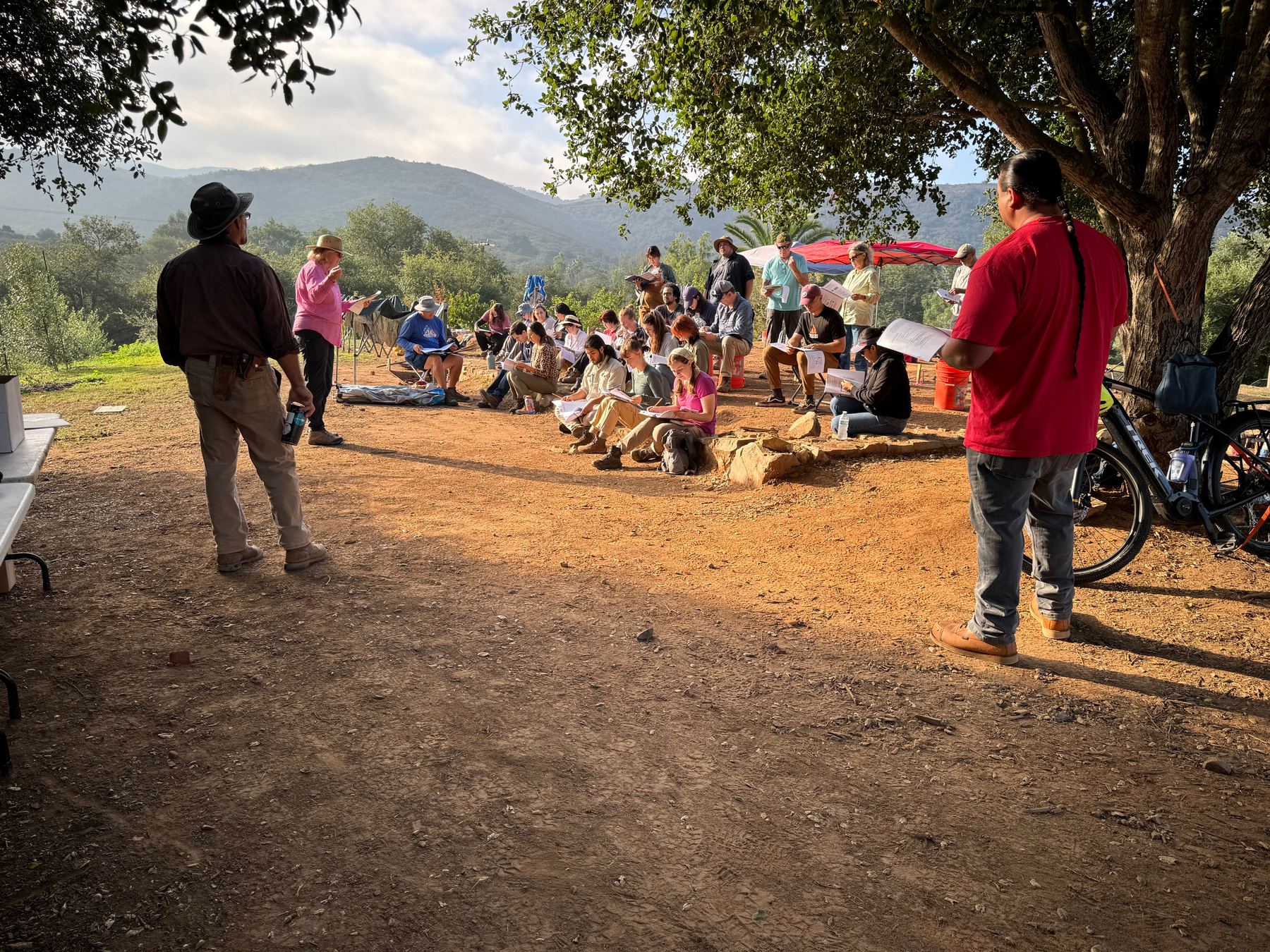
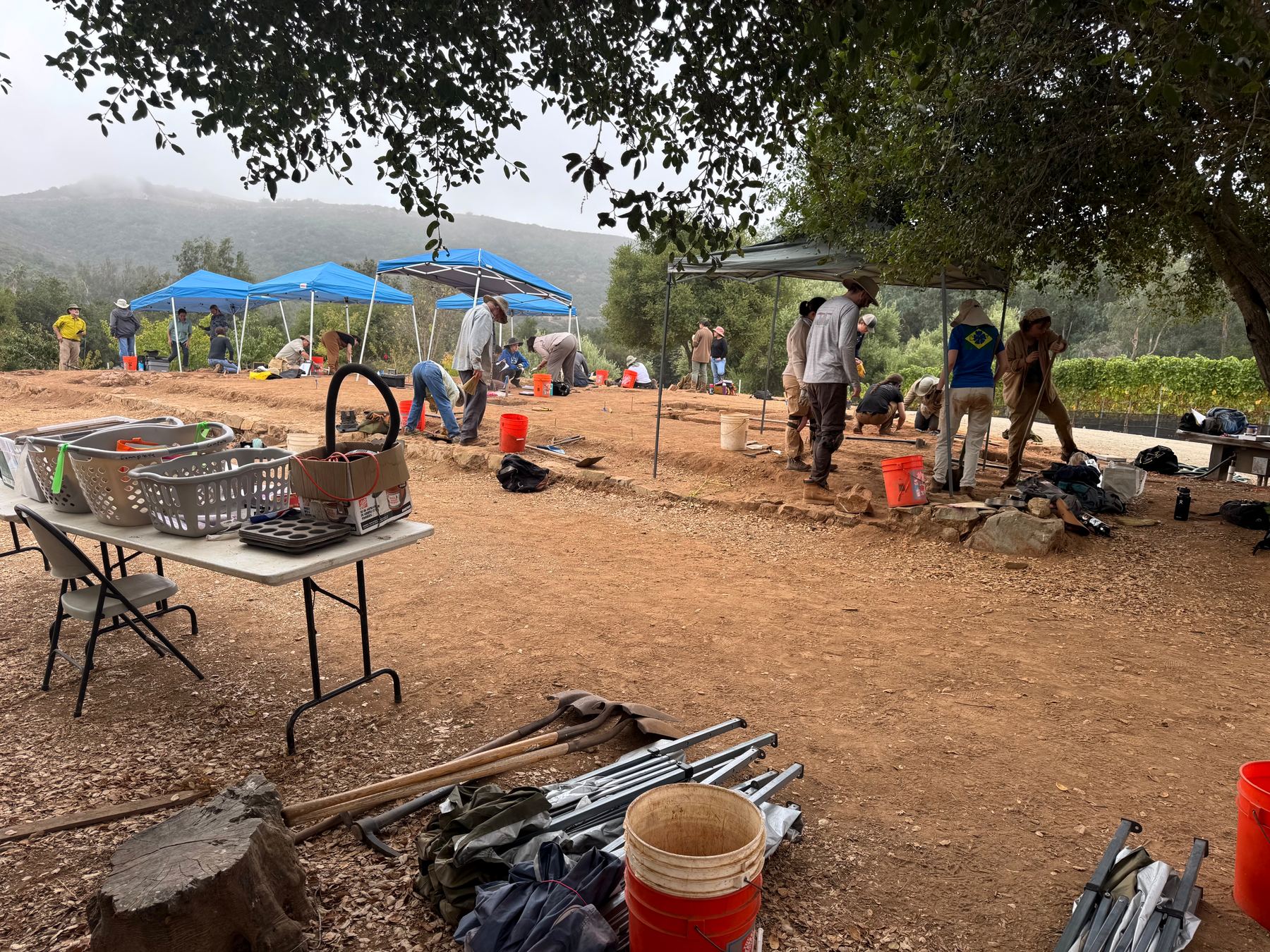
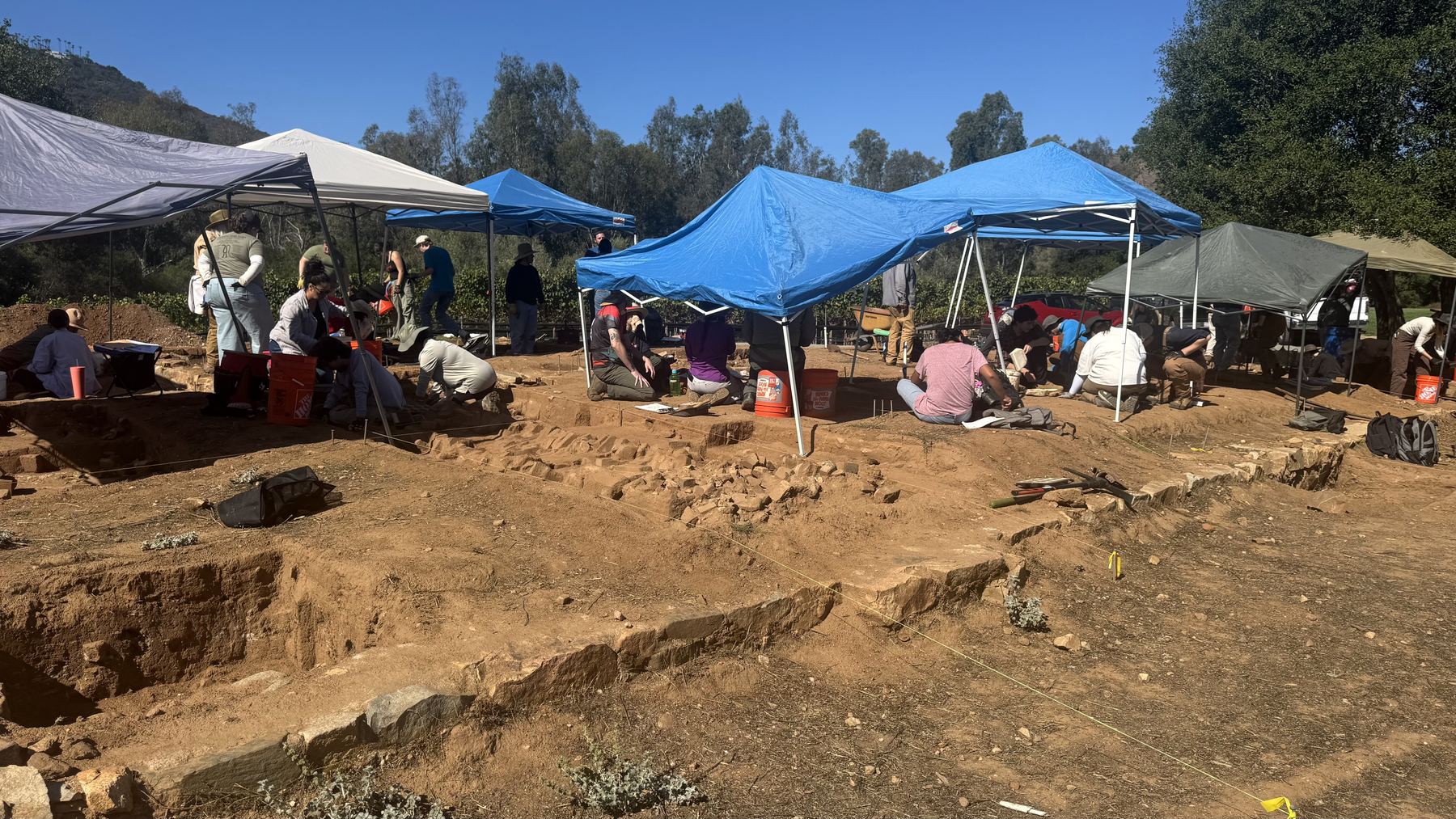
The Palomar College Archaeology Program — its A.A. and its Certificate of Achievement — came onto the property in March 2023 and stayed through the fall of 2025. Three years. Elizabeth “Betsy” Pain, M.A., RPA, professor of anthropology, was principal investigator and wrote the Field Excavation Manual. Jim Eighmey taught with her. Philip de Barros, Mike Thacker, Alexa Clausen, and Sue Hagen contributed to that book. Anthropology 120 and the advanced 205/206 courses met most Saturdays, eight to noon and one to four. Students were guests. They were also being trained to work independently as field assistants on typical Southern California sites. The class excavated historic remains and treated the knoll as ground with a much older Native sequence — Harmony Grove occupation that Palomar, following Dennis Gallegos, reads back thousands of years.
The manual is specific in the way good field manuals are: retrieve equipment, excavate, screen, record, lunch, excavate again. No drugs, cigarettes, or alcohol. Pack out trash. You represent the college when a visitor asks a question. The address on the handout is this address. Pain named Elena so that students would know the household was not anonymous; the closer kinship, as Clausen insists, is to Cave Johnson Couts, Sr., and Ysidora Bandini Couts of Guajome and Buena Vista. On September 2 of the first fall they toured the site with Greg and Alexa. Later weeks covered mapping, soils, the Harris matrix, historic artifacts, faunal remains, DPR forms, ethics. A Kumeyaay guest lecturer came in the week of Native American Day.
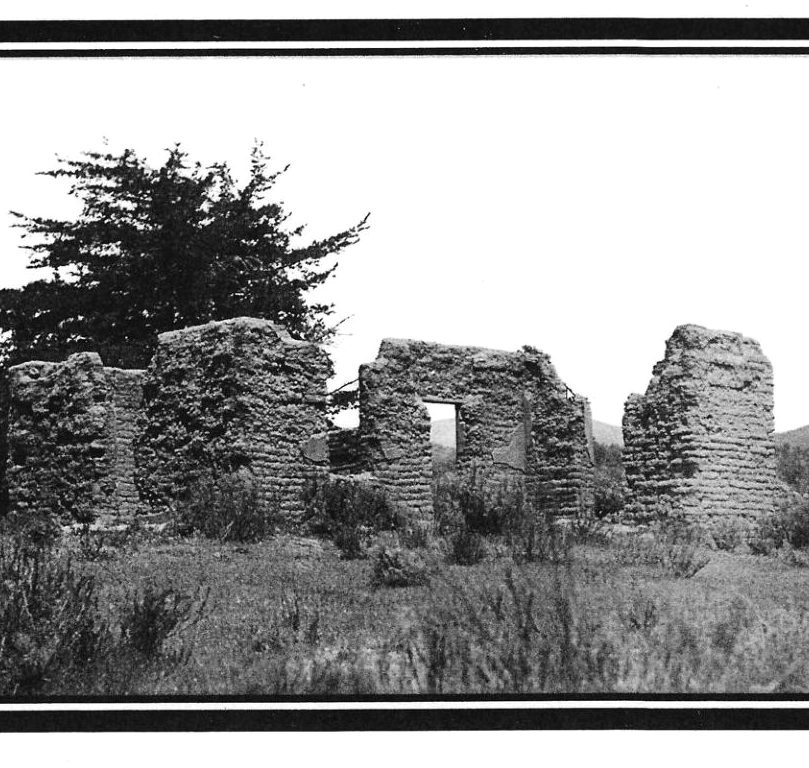
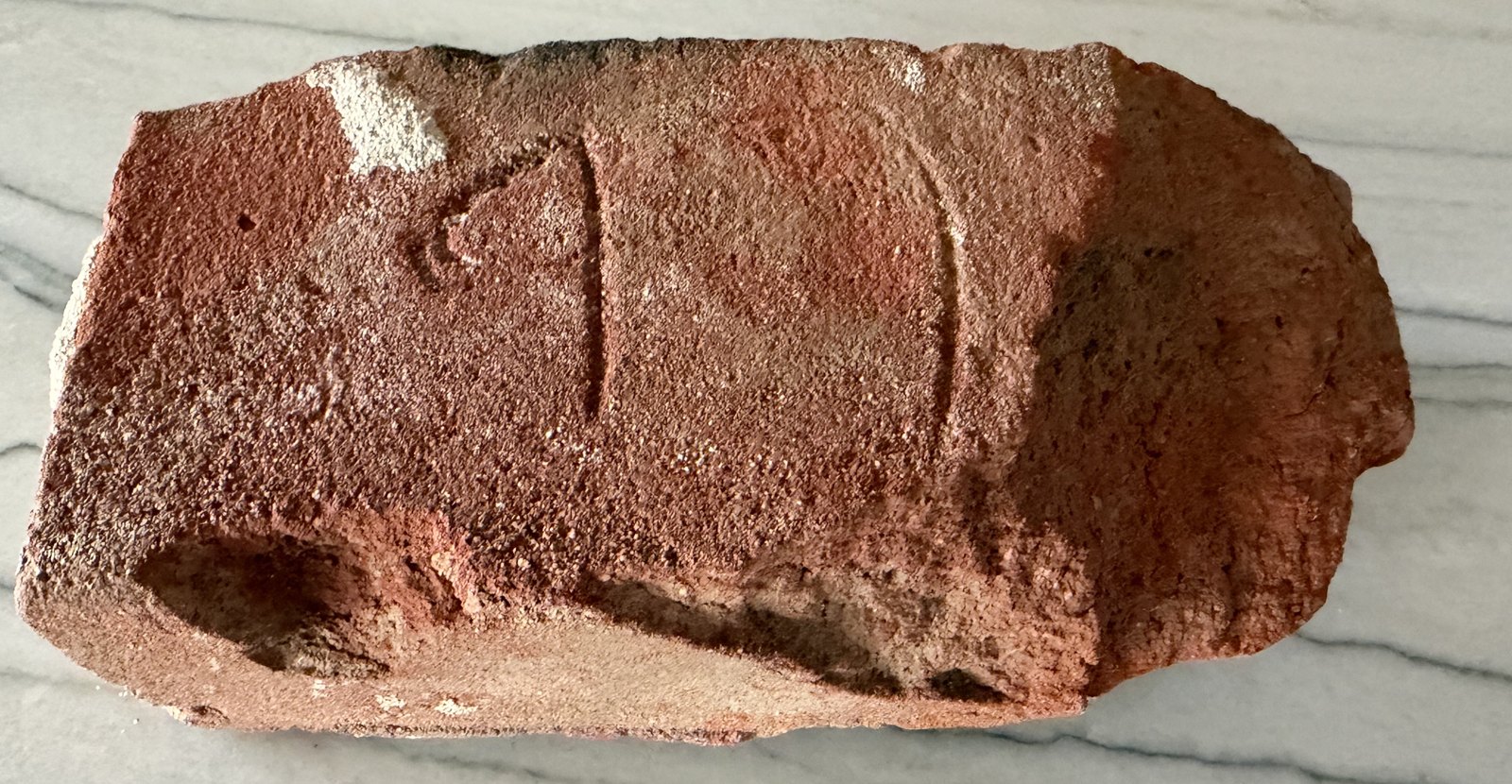
The excavations uncovered architectural facts the letters could only imply: the size of rooms, the location of a wooden porch, the remnants of a collapsed large fireplace, and a brick from the chimney marked “97.” Palomar students found that brick in the wreckage after the fireplace had fallen into the center of the adobe. It is the year the knoll house was raised. No roof tiles were uncovered. Miscellaneous artifacts came up as well: parts of a toy train, a button, a doorknob. The catalog Hagen later published sorts historic ceramics, glass with date ranges, metal, shell, household miscellany. The assemblage is thinner than a nine-year occupation might suggest, because the Dear adobe was severely vandalized after about 1925. Limited finds are themselves a finding.
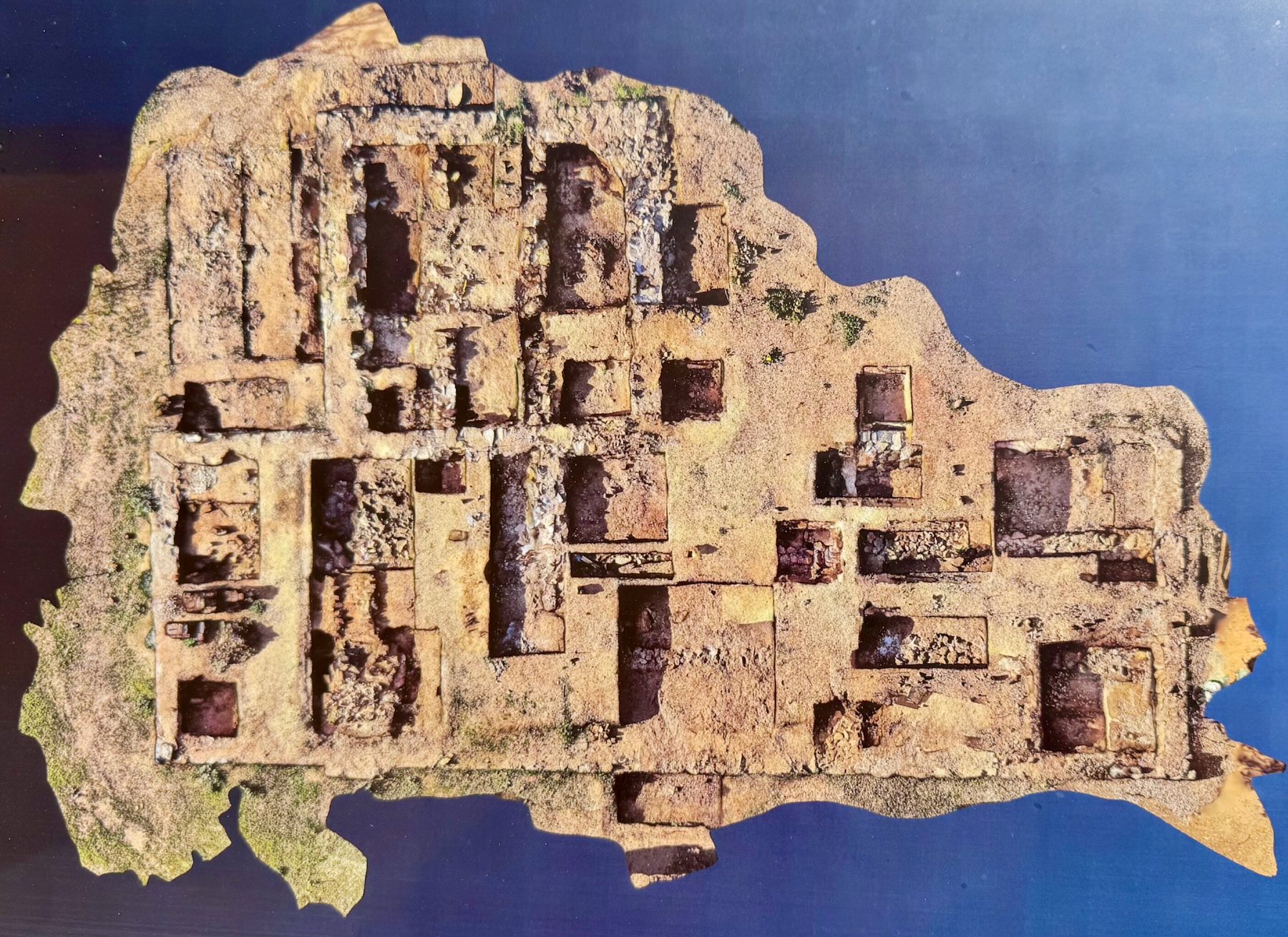
Units were laid out in teams of three or four, beginners paired with experienced students when possible. They screened, bagged, labeled, and kept journals. Mike Thacker mentored across seasons. Sue Wade and Steve van Wormer shared expertise. The list of students who gave permission to be named is long on purpose. Field schools are collective. Hagen’s questions were pointed. Did the assemblage expand the documentary history, especially of Elena, who had bought the estate and finished the house with her own money? Did it show transitions of occupation, or markers that the Dears had kept or lost the lifestyle of Guajome and Santa Rosa? Her conclusion is modest and useful: the papers still tell more of daily life than the artifacts do, and the artifacts open a wide door for work that has not been done yet. That is what a first excavation should say. One student later assembled a LiDAR composite with an Apple iPad. It is the three years in one view.
Alexa Clausen’s occupant table in the field manual carries the ranch past the Dears. Imogene Sailor, 1904 to 1909 — Walter her son, Annie Mitchell, Egbert, Dortha. A Pool family with six children in 1910. J. M. and Elizabeth Taylor by 1912, J. Chauncey Hayes Jr. renting from them. John T. Lee, last resident, in Walter Sailor’s telling. Greta Woodson boarded as schoolteacher in 1900. Ed Fletcher’s name is on the list without a date. The 1959 Harmony Grove guide already had the adobe ruins in use as a pen or stable. The thesis — The House Elena Built: Historical Archaeology of Las Violetas (CA-SDI-4674) — was approved in December 2024 at California State University, San Bernardino, with Matthew Des Lauriers as chair and Danny Sosa Aguilar and Elizabeth Pain as members. It is the first published archaeology of this ranch. It will not be the last if the site is treated as a research partner rather than a backdrop.
Students will take part in an actual archaeological excavation aimed at introducing students to archaeological field methods while exploring prehistoric as well as historic remains.
Sources for this chapter
- Pain, Betsy, M.A., RPA. Palomar College Archaeology Field Excavation Manual. Elfin Forest Adobe, ANTH 120/205/206. Contributions by Jim Eighmey, Philip de Barros, Mike Thacker, Alexa Clausen, and Sue Hagen. Palomar College, San Marcos.
- Palomar College. Fall 2023 Archaeological Excavation syllabus. Instructors: Betsy Pain and Jim Eighmey. Field location: 19993 Questhaven Road.
- Hagen, Sue. The House Elena Built, 2024. Acknowledgements and Chapter Four.
- Clausen, Alexa. Occupant table and Parker Dear biographical notes in the Palomar field manual; notes on the 2017 documentary search, 2026.
- White, Greg. Field photographs of the Palomar excavations, including 4 October 2025, and the chimney brick marked “97.” Student LiDAR composite of the three-year excavation, made with an Apple iPad.
The same knoll
Stand here for a day.
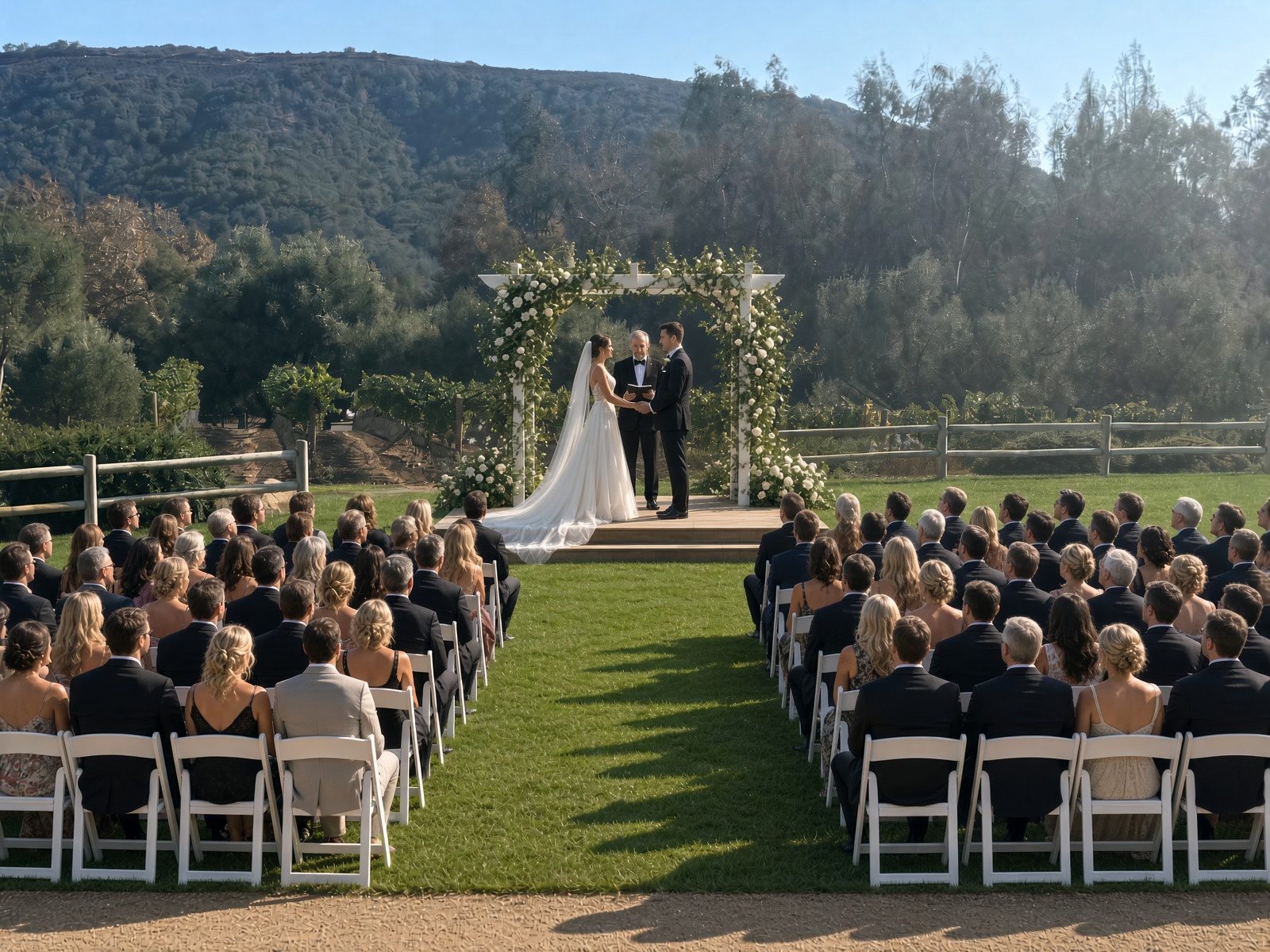
Gatherings of up to seventy-five. A ceremony on the south lawn, cocktails on the terrace, dinner outside. The suite is booked only on Airbnb.
Inquire