
CA-SDI-4674
The Dig
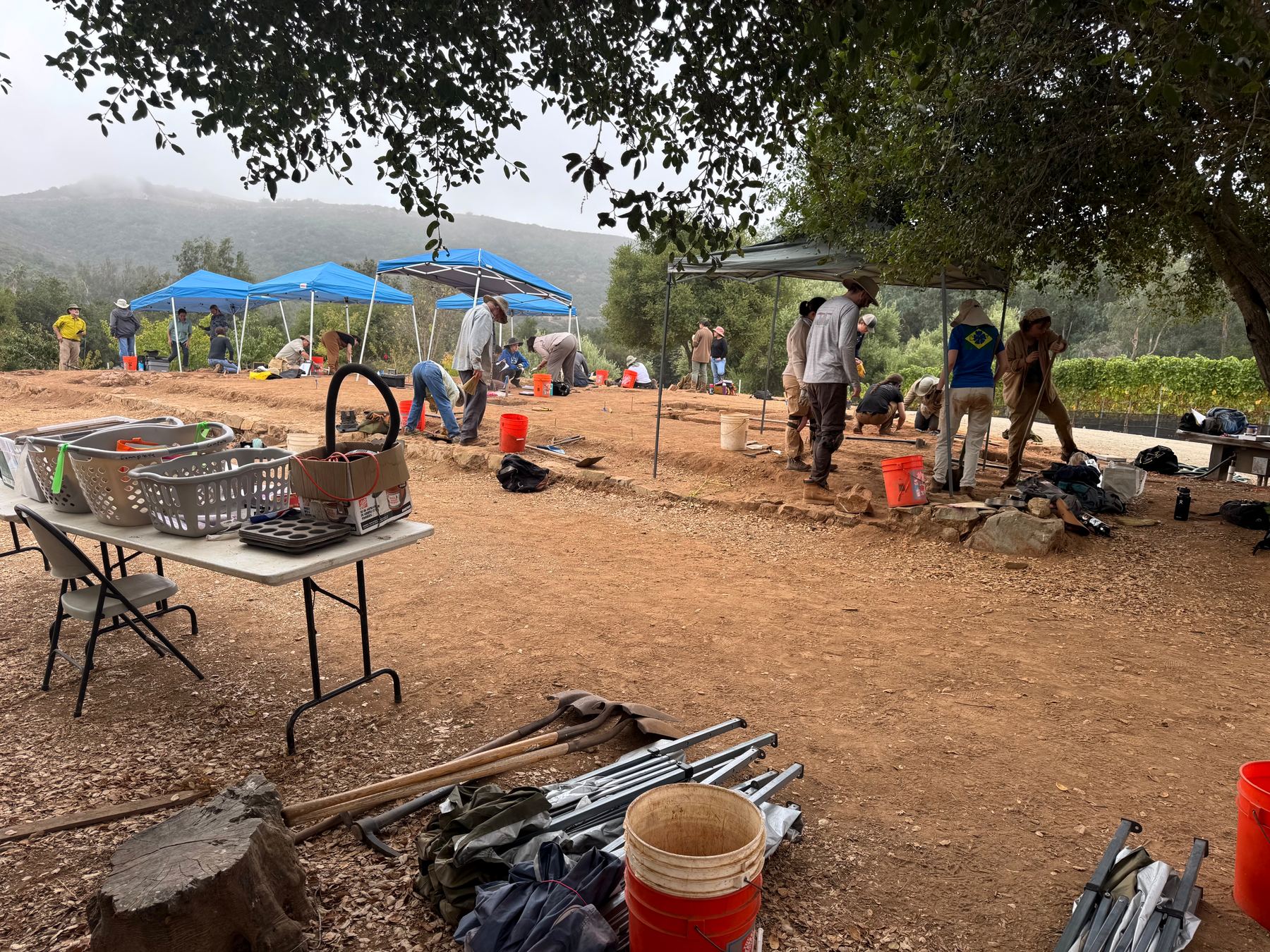
In February 2019 the outline of a foundation came out of the yard. The house already stood. The stones had no name yet. Historian Alexa Clausen opened the documentary trail. Palomar College brought the trowels from March 2023 through fall 2025 — three years. Sue Hagen wrote the first thesis.
Alexa Clausen
When Greg and Céline White uncovered clumps of adobe and a straight line of foundation stones — Greg had been digging places to plant fruit trees — they photographed the outline in February 2019. The present house already stood. They did not yet know whose foundation it was. Greg went to the Escondido History Center and was connected with Alexa Clausen, a retired California State Parks historian. Together they spent years on ownership and occupancy — deeds, notices, names the ranch gathered (Las Violetas, the Dear Adobe, the Parker Dear place, the Taylor place, El Aliso). The paper trail had gaps. That is why a college was asked to dig.
Palomar College
Elizabeth “Betsy” Pain, M.A., RPA, professor of anthropology, became principal investigator and wrote the Field Excavation Manual. Jim Eighmey, professor of anthropology, taught with her. Philip de Barros, Mike Thacker, Alexa Clausen, and Sue Hagen contributed to that book. The Palomar Archaeology Program — its A.A. and Certificate of Achievement — came onto the property in March 2023 and stayed through fall 2025. Anthropology 120 and 205/206 met most Saturdays, 8:00–12:00 and 1:00–4:00. Students were guests, and they were being trained as field assistants. Historic adobe, and a much older Native sequence on the same ground. Pain named Elena Couts Dear so no one would treat the household as anonymous. Her parents, Cave Johnson Couts, Sr., and Ysidora Bandini Couts of Rancho Guajome and Rancho Buena Vista, are the closer kinship.

What the units produced
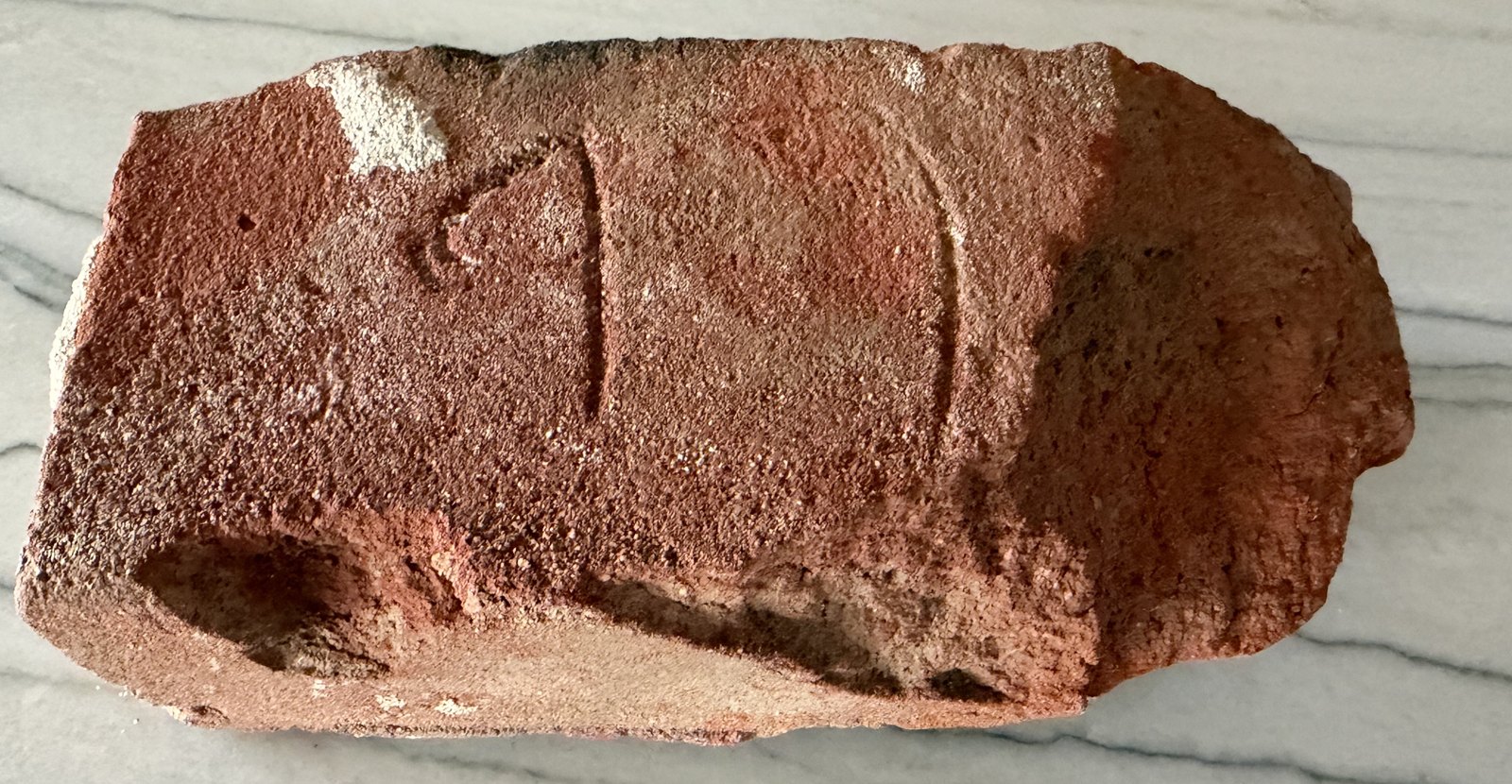
The units mapped rooms, a wooden porch, the remnants of a collapsed large fireplace, and a brick from the chimney marked “97.” Students found it in the wreckage after the fireplace had collapsed into the center of the adobe — the year Parker raised the knoll house at Elena’s request. No roof tiles were uncovered. Parts of a toy train, a button, a doorknob. Hagen’s 2024 CSUSB thesis, The House Elena Built: Historical Archaeology of Las Violetas (CA-SDI-4674), is the first published archaeology of the ranch. The catalog sorts historic ceramics, glass, metal, shell, and household miscellany. The assemblage is thinner than a nine-year occupation might suggest: after about 1925 the adobe was severely vandalized. Letters and newspapers still carry more of Elena’s daily life than the sherds; that is a proper first excavation.
Committee: Matthew Des Lauriers (chair), Danny Sosa Aguilar, Elizabeth Pain. Mentors on site included Mike Thacker; Sue Wade and Steve van Wormer shared expertise across seasons. A Kumeyaay guest lecturer spoke during Native American Day week. The ranch sits in a living landscape, not a closed exhibit.
Field school, 2023–2025
- Where
- 19993 Questhaven Road, Elfin Forest. Private land, opened for teaching.
- Who
- Pain (principal investigator, RPA) and Eighmey; Palomar Anthropology 120, 205, and 206. Manual contributions from de Barros, Thacker, Clausen, Hagen.
- When
- March 2023 through fall 2025. Most Saturdays, 8–12 and 1–4. Three years.
Students who permitted their names in Hagen’s acknowledgements include David Bavencoff, Ahnalee Fritz, Emalee Gaines, Jasper Graham, Abraham Haller, Brianna Hartley, Nathan Hughes, Keith Klipfel, Christina Livingston, Luis Mayoral, Ajeng McCunney, Andriana Means, Kristina Moore, Britt Perez, Jocelyne Reyes, Mari Ridenour, Selma Smith, and Sage Walsh — and every classmate who dug beside them.