

Chapter X · 10 of 12
The Lady Dressed in White
Teens on the Harmony Grove road, a Town Council welcome guide, and Elfin Forest’s most enduring legend.
Ask a number of adults who came of age in San Diego’s North County about their road trip into Elfin Forest. Unknown to their parents, they will confess that they, and a carload of other teens, drove the dark and winding roads of Harmony Grove and Elfin Forest late at night to ghost-hunt. To this day those stories are entrenched in the local lore. To answer questions about the myths, Elfin Forest’s Town Council Welcome Guide has long tried to give new residents both: a few facts, and the tales that had already grown on them.
The census named families. The inquest named a date and a path. Folklore names a feeling. In 1986 the Elfin Forest Greeters, publishing a Community Guide for the Town Council, were honest about the mixture. Newcomers wanted to know what the name Elfin Forest meant, who homesteaded first, who had used the metate in a yard, who owned the cowbell and the hand-forged horseshoe. Legend rushed in to answer what deeds left open.
Even the name is a fork. The Guide cites San Diego Union articles attributing “Elfin Forest” to managers of Questhaven Retreat on Questhaven Road. It also records another origin: Dr. Harvey Urban, a San Diego dentist, bought twenty acres with Jack Donnelley and George Dew as a vacation place. Friends called it Tooth Acres. Urban’s five children, having just finished a book titled Elfin Forest, used that instead. Naturalists had long used “elfin forest” for chaparral — scrub, bush-forest, elfin-wood, heath-scrub — the cover this climate actually grows. All three accounts can be true in their registers: a plant community, a retreat’s language, a children’s book on a dentist’s hill.
One ghost story has endured. At the center of it is a lady who moves through Elfin Forest late at night in a white dress. The 1986 Guide calls her the official ghost. She has been seen floating toward houses and in front of cars, and is blamed for accidents. Teenagers made a night of it: the Questhaven or Elfin Forest Cruise, looking for her. One version has a woman whose husband and son came west looking for land, were killed, and whose house in Harmony Grove or Questhaven then burned; she wanders still. Another version sets an English woman and her husband at a stagecoach stop in the late 1800s, attacked and burned; she hides two children in a hollow tree, and searches afterward as an ectoplasmic cloud, sometimes on a white horse. These are tales. They are not the inquest. They are not Kumeyaay history. They are not Imogene Sailor’s 1927 fiction, in which two women in calico walk toward an adobe at noon. Folklore borrows. It does not file citations. The stories say more about who told them, and when, than about any documented death on this creek.
The Guide is also funny, which local history should be allowed to be. Before the gate went up at Questhaven, teenagers drove up the retreat road and made the usual noise. One resident, grey hair down, put on a light-colored robe, took a flashlight, and came through the trees to chase them off. “Oh, the stuff that legends are made of,” the Greeters wrote, “especially when you are 16 or 17 years old and ‘cruising’ Spooks Canyon at night.” A woman with a flashlight will not kill a legend. It will, if you print it beside the legend, keep the chapter honest.
Other stories sit in the same pages. An English bellringer walks Harmony Grove with a lantern. A group of Indians, the Guide says, were “buried standing straight up” — folklore, not archaeology, and not a thing this book repeats as fact. Spooks Canyon may come from a Welshman named Spook who homesteaded in the 1880s, whose orchard was still remembered in 1971, or from the spiritualist meetings at Harmony Grove, or from both. The Harmony Grove Spiritualist Association has been at the south end of Country Club Drive since 1896: the same decade as the Dears, the school, and the inquest. A stage route, the Guide says, ran Ramona to Escondido, followed Escondido Creek, turned west to Encinitas, then south to San Diego. A man named Parkrider kept a store near Harmony Grove and Elfin Forest Roads; adobe ruins were still there in 1986.
The 1986 history also notes Native presence in Harmony Grove — mortars, metates, pictographs — in the language of its decade. Kumeyaay people are the living community of this landscape. Palomar’s field school made room for that with a guest lecturer in the week of Native American Day. Legend is not a substitute for that history, any more than a flashlight is a substitute for a ghost. The lady dressed in white belongs in this book because later residents used her to name fog, fear, and a canyon. The census named the families. The inquest named a night. Folklore named what it could not cite. All three, labeled as what they are, are local history.
The official ghost is the White Lady.
Sources for this chapter
- Elfin Forest Greeters / Elfin Forest Town Council. Elfin Forest Community Guide, 4 July 1986. “The Elfin Forest — A Brief History.”
- Sailor, Imogene. “Noon Shadows.” Overland Monthly and Out West Magazine, October 1927. Earlier printed fiction from a renter of the knoll adobe; not the same tale as the White Lady.
- Clausen, Alexa. Notes on local folklore and the Welcome Guide, 2026.
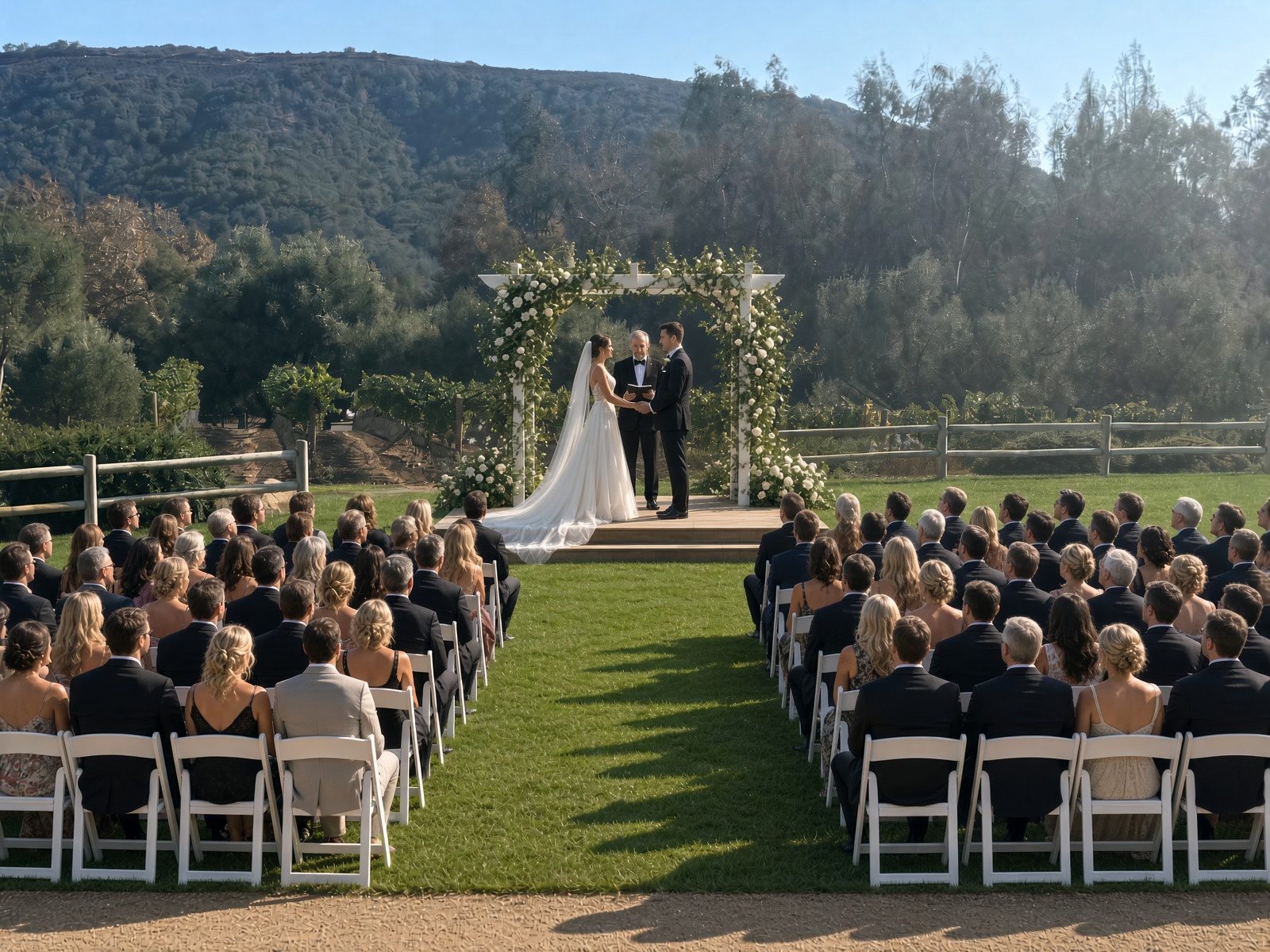
The same knoll
Stand here for a day.
Gatherings of up to seventy-five. A ceremony on the south lawn, cocktails on the terrace, dinner outside. The suite is booked only on Airbnb.
Inquire