
Chapter III · 3 of 12
The House Elena Built
Daughter of Cave J. Couts and Ysidora Bandini Couts, she buys the Minter estate, names it Las Violetas, and has a new adobe raised on the knoll.
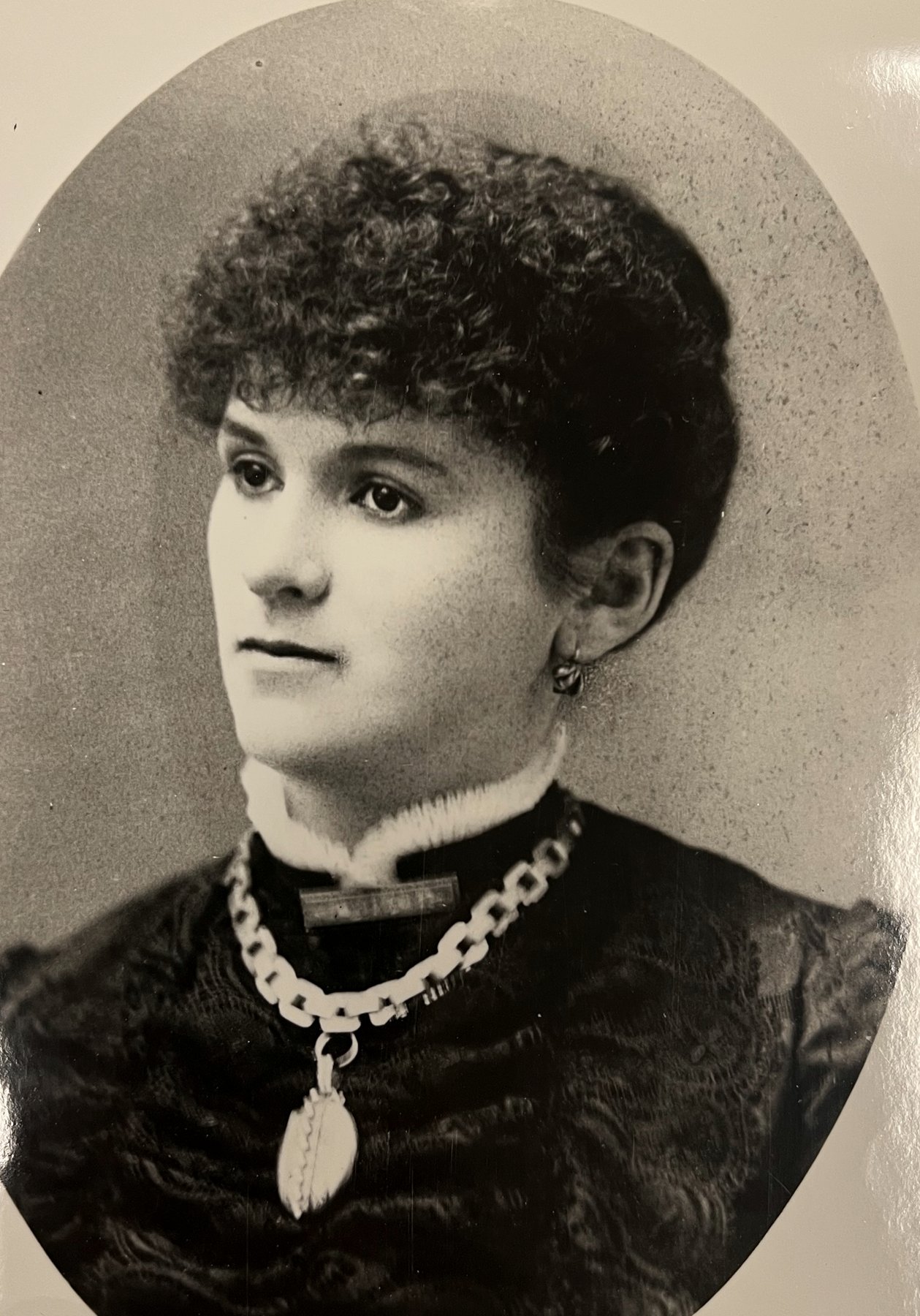
Elena Couts Dear is the person the archaeology chose to follow. Not because the other occupants were unimportant — the site has a table of them — but because the documents, the letters, and the house itself keep returning to her. She purchased the Minter estate from his adult children. She named the ranch Las Violetas. She paid, from her own means, to finish a new adobe on the knoll. In a county that often files women’s names under their husbands’, that fact is the hinge.
She was Elena Francisca Couts, born 18 August 1862 at Rancho Guajome, daughter of Cave Johnson Couts, Sr., and Ysidora Bandini Couts, who held Guajome and Rancho Buena Vista. Juan Bandini is her grandfather; he is not the player on this knoll. Guajome was Abel Stearns’s wedding gift to Ysidora in 1851 — a twenty-room adobe finished in 1853, orchards, a vineyard, irrigation, and the labor of hundreds of Indian workers. Elena grew up in that house, in a world of parlors and ranchero obligation. In 1881 she married Parker Dear. He was not a Californio heir. Born in Liverpool, he had been sent from England at seventeen, in 1876, to inspect Rancho Santa Rosa for his father, John Dear; English capital bought into that Temecula grant ranch after the report. They made its fourteen-room house the social hub of the country — May Day picnics the newspapers still remember. Flood, a wrecked rail scheme, and foreclosure around 1893 took it. They did not come straight to Aliso. Hagen traces them next to Guajome and to the Myers House in Oceanside, then, in April 1895, to the Minter estate they would name Las Violetas.
The knoll was not the first fight over land in her name. Late in 1886 Parker and Elena — Helen Couts Dear in the complaint — sued Ysidora and Richard O’Neill, who held a mortgage on Guajome. They alleged that when Elena planned the marriage, Ysidora had executed an unrecorded deed for 2,020 acres, later lost from a trunk, and asked either the land or $50,000. They also asked the court to set aside Ysidora as executrix: insufficient English, “American ways,” advice from incompetents — meaning, plainly, young Cave Couts, Jr. The petition was denied in January 1887, days before Cave married Elizabeth B. Clemens. Nine years later, as the Dears closed on Las Violetas, they sold Cave and Lily their remaining Guajome interest for $2,000. Lily brought $1,000 to San Diego; Cave promised $500 in sixty days and $500 in six months, and insisted on a deed, not a trust deed. The instrument is dated 3 April 1895. Parker’s letters of late March are the same money, seen from the other side of the table.
She did not buy a small adobe as a finished house. She bought Minter’s estate. The Dears moved into a small adobe already on the place — its builder still unknown — and outgrew it. Parker’s letter of 4 June 1895, written from Las Violetas to Elizabeth B. Clemens Couts Schrader (Lily), is the voice of a man already at home in the name Elena had chosen. Friends had noticed the heading on the stationery. He had fifteen acres of vineyard and was thinking of the wine business. The quarters were cramped: seven of them, and talk of a teacher. He was, as Alexa Clausen reads him, seemingly unconcerned about providing a livable house compared with how they were already living in the adobe below. He would, if he could afford it, turn that house to a winery and build above on the hill. They would make adobes the next week, at least for a kitchen.
The knoll house went up in 1897, on Elena’s request, Parker doing the raising. A brick in the chimney is marked “97.” No roof tiles were recovered in the excavations. Parker’s letter of 4 June 1895, written from the cramped lower adobe, had already mentioned talk of a teacher. That summer a young woman had been chosen to teach the Aliso term and wanted to board with them at twenty dollars a month; the new rooms needed to be ready by mid-September. Parker and Elena gave her a small living space in the westernmost wing — the space now called the School Teacher’s Room. A district teacher boarding with a local family was the ordinary rural practice. She is not named in the surviving public sources. Elena wrote to her brother Cave Couts, Jr., about money to finish the house, and of selling her rings “at a sacrifice.” She had been willing, Clausen notes, to sell jewelry to acquire the Minter estate at all. Inheritance from Guajome and Buena Vista paid, over the years, for travel and for luxuries the contraction had not entirely cancelled. She had borne five sons. She had been ill — fainting spells, “attacks,” work the doctor did not want her to do. The newly constructed adobe on the knoll could not be compared to Santa Rosa. Parker’s letter does not pretend that it could. It also does not sound like a man in despair.
They would spend nearly ten years under the name Las Violetas, with a gap when the household shifted to Otay and back. Sue Hagen’s thesis reads the occupancy through feminist archaeology at the household scale: not to romanticize hardship, and not to pretend the Dears became poor in any ordinary sense, but to ask what a woman of Elena’s background did when the rooms got smaller. The answer in the documents is practical and stubborn. She bought the estate. She named it. She finished the house. She wrote to her brother. A later letter to him survives from 1938, decades after they left the knoll. The correspondence is not a novel. It is better than a novel for this purpose: a voice across the ordinary business of family, money, health, and place.
She grew up in a wealthy, well-known family in San Diego County. Their fortunes changed, and they settled in this small home — a stark contrast to the life they had before.
Sources for this chapter
- San Diego History Center. Studio portrait of Elena Couts, about 1880. Catalog 10861-2, People.
- Hagen, Sue. The House Elena Built: Historical Archaeology of Las Violetas (CA-SDI-4674). M.A. thesis, California State University, San Bernardino, 2024. Santa Rosa, foreclosure ca. 1893, Guajome and the Myers House in Oceanside, then Las Violetas in April 1895.
- Bollinger, Sharon Loughlin. Cave Johnson Couts, Jr. — Last of the Dons. M.A. thesis, University of San Diego, 1976. Digital USD. Baptismal list (Elena Francisca, 18 August 1862); 1886 Dear–Couts suit; 3 April 1895 deed of the Dears’ remaining Guajome interest.
- Huntington Library. Cave Couts Papers. CT 522 (Elena to Cave Couts, Jr., 1897); CT 544 (Parker Dear to Elizabeth B. Clemens Couts Schrader, Las Violetas, 4 June 1895).
- Clausen, Alexa. Notes on Elena’s parents, the Minter purchase, and the 1897 knoll adobe, 2026.
The same knoll
Stand here for a day.
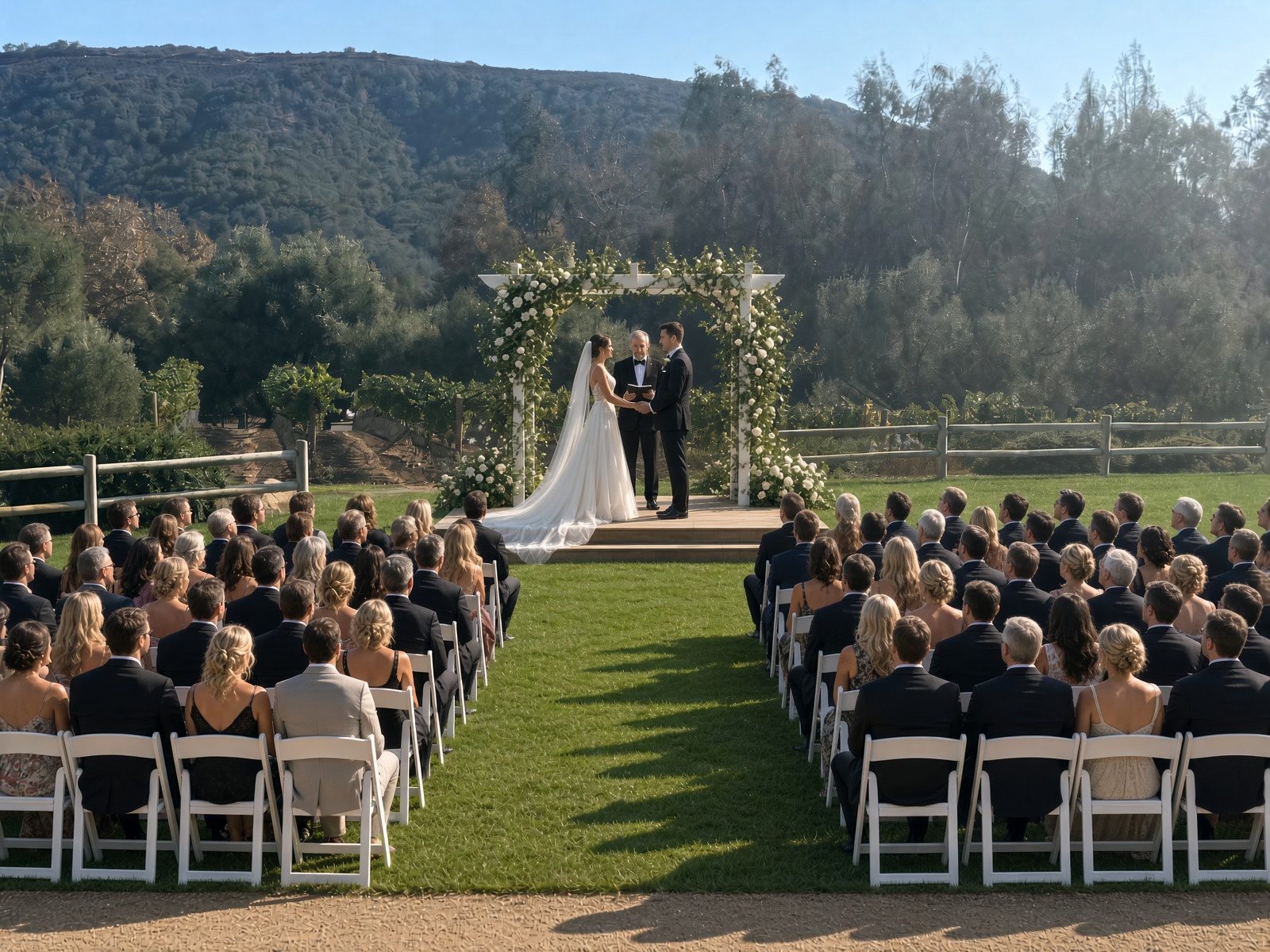
Gatherings of up to seventy-five. A ceremony on the south lawn, cocktails on the terrace, dinner outside. The suite is booked only on Airbnb.
Inquire