

Chapter II · 2 of 12
John S. Minter, Sr.
A homesteader and widower farms the knoll, calls his ranch El Aliso, and his children pass the estate to Elena Dear.
Escondido’s homestead era is easy to skip in county histories that prefer the great Mexican land grants. The ranchos have archives and famous names. Homesteads have patent files, neighbors’ memories, and whatever a later owner bothers to ask. John S. Minter, Sr. belongs to that second, quieter record. He is a homesteader on this ground. He is not, in the sense the word is used for the grant ranchos and the first American towns, a pioneer.
The story worth telling is the work. A widower, he raised school-age children and kept farming as he aged — some twelve years on this place, from about 1882 to 1895. He filed a homestead on 23 May 1888 and received the patent on 3 September 1890: 161.98 acres. As the claim required, he built a wood-frame house and planted fruit trees. He also bought William Connors’ ground and turned the combined holding into a productive farm and ranch. Grapes and olives were part of that bet; cuttings may have come, as they often did in this county, from the old mission and rancho stock. The land stayed in farm use for decades after he proved it up.
His deceased wife was Serafina. Her people, and the children’s, run into the Machados and the Israels — names that later sit on the Aliso School census beside the Minters, the Connors, and the Lusardis. That is how a homestead becomes a neighborhood: not by a landmark tree alone, but by kin who stay within walking distance of the same schoolhouse.
Helen Minter Connors, his daughter, is the witness for the name El Aliso. She said that is what they called their ranch. She did not say the canyon took it from them. The distinction matters. Early papers still speak of San Elijo. Aliso, as a district name, gathers around the school and the precinct in the 1890s. What Minter left is the farm, the wood-frame house (now gone), and a daughter’s memory of a sycamore.
After his death the adult children conveyed the estate. The Dears were already living on the place by April and May of 1895; the recorded deed from John S. Minter, Jr., and his wife to Helen I. Dear — Elena, in the American spelling she used on paper — is 6 May 1897. The next chapter of the knoll would be written by a family who had known much larger rooms. They would not occupy Minter’s frame house as the house of record. They would outgrow a small adobe of unknown origin on the slope, and raise another.
Sources for this chapter
- Hagen, Sue. The House Elena Built, 2024. Homestead patent, wood-frame dwelling, and the 1897 transfer from John S. Minter, Jr.
- Bureau of Land Management. John S. Minter, Sr., homestead application 23 May 1888; patent 3 September 1890.
- Clausen, Alexa. Documentary notes on Minter’s tenure, Serafina’s people, and the El Aliso name, 2026.
- White, Greg. “John S. Minter, Sr., Pioneer and Homesteader, Names Aliso.” Chaparral, Spring 2022. Title retained as published; the reading of “pioneer” is not followed here.
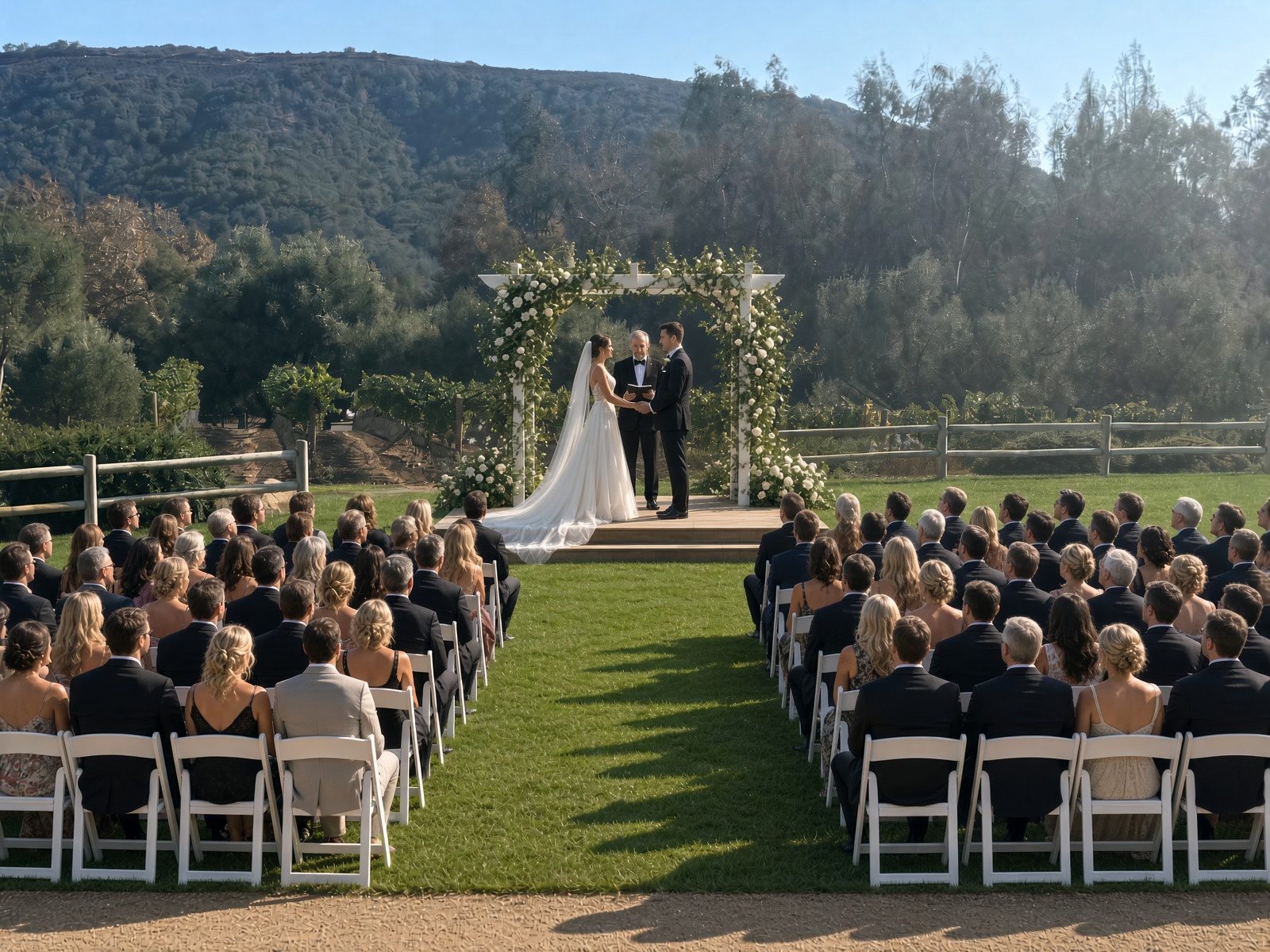
The same knoll
Stand here for a day.
Gatherings of up to seventy-five. A ceremony on the south lawn, cocktails on the terrace, dinner outside. The suite is booked only on Airbnb.
Inquire