

Chapter V · 5 of 12
Aliso School
A one-room school older than the Dear deed, a district census, and the homestead families who sent their children there.
Listen
Told by Eve
Half a minute. The young woman who boarded in the westernmost wing in 1897, and the brick marked “97.”
Throughout the United States, little schools sprang up as the ordinary way to educate rural and farm children. They were also community centers, and very often polling places. Teacher turnover was high. A term commonly held fifteen to thirty pupils. Such was Aliso School — and, as Alexa Clausen reads the local record, it had a more colorful past than many of the other one-room schools in San Diego County.
The school was older than the Dear gift of land. District census marshals were already naming Aliso families in the year ending 30 June 1891, four years before Elena and Parker moved onto the Minter estate. On 19 February 1899 — a decade after the neighborhood is visible in the 1889 Union, and well after the census had begun — Parker Dear and his wife deeded a half-acre to the Aliso School District. Whether that half-acre at what is now Questhaven and Elfin Forest Roads is a new site, or a confirmation of ground the school already used, is still an open question. A letter of the late 1890s has the schoolhouse moved across the road from an old stable and improved. The coroner’s inquest of August 1898 already puts a schoolhouse on the Dear ranch: Jose Morena, a witness said, lived on the other side of it.
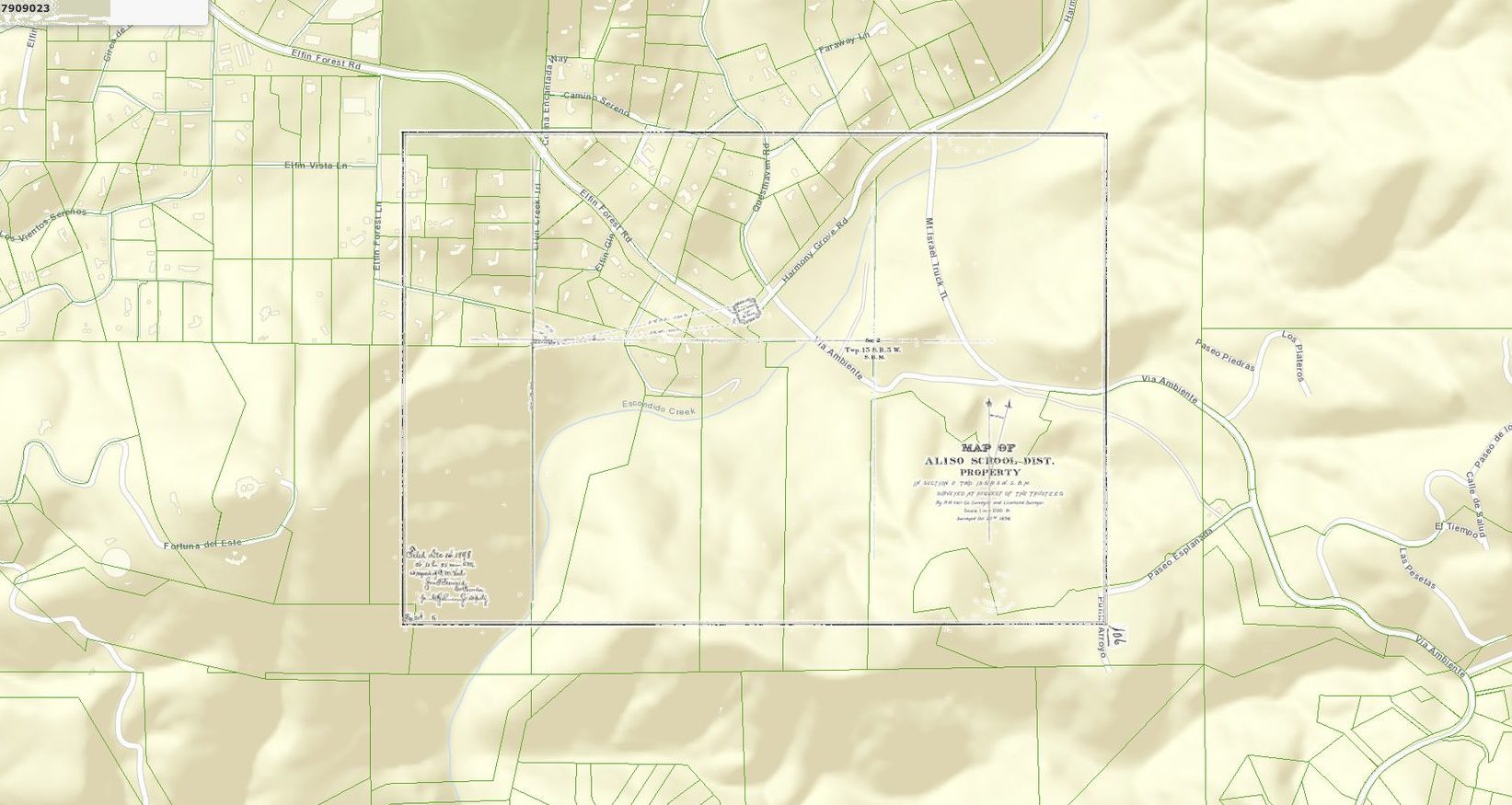
What survives as a list of neighbors is the school census. Each year a marshal of the Aliso District named the parents and guardians who had children of school age. The reports, later printed by the San Diego Genealogical Society in Leaves & Sap, run from 1891 through at least 1901. The marshals were the neighbors themselves: M. Davis, George A. Connor, Mrs. B. R. Robinson, J. P. Israel, E. M. Searles, Lewis Weller, Herman Bumann, Katie L. Connors in 1901, John C. Suydam after that. A woman of the Connors household signing the official count is not a small thing in a county that often filed women under husbands.
The names on those rolls are the homestead map of Aliso. John S. Minter and John S. Minter, Jr. appear in the early nineties. Parker Dear is listed in 1896 with five boys — the household the adobe still remembers. The Connors fill more lines than anyone: George A., James W., William E., Paul, L. W., and Katie L. Francisco Lusardi, Frank in some years, is there. Herman Bumann is there, and in 1900 he takes the census himself. J. P., J. W., and R. L. Israel. Ferdinand Koehn and August Schmidt, who would sit on a coroner’s jury two years later. Jose Maria Morales. E. R. Davis, Lilburn A. Williams, Josiah M. Stark, Adam Wiegand, Mary Burton, Philip Sanchez, J. H. Barham, E. M. Searles, Lewis Weller, Jose G. Moreno, Francisco Alto, Mrs. Alvana Reyes, W. H. Reeder, Marcelino Orosco, Eugene Morales. The spellings wander, as rural census spellings do. The families do not.
A census is not a novel. It does not say who liked whom, or which child learned to read first. It says the Lusardis, the Connors, the Israels, the Bumanns, and the Moraleses sent children to the same small school as the Dears and the Minters. That is the social fact. In 1898 Parker Dear Jr. was at the schoolhouse at noon when trouble ran down the canyon. George Connors, fifteen, was at school when Parker came saying a man was going to kill his father. The school was close enough to the adobe that the neighborhood’s crises passed through it. When Parker later sought to sell wine from the old adobe, neighbors would tell the county that a winery and a bar did not belong next to schoolchildren. The protest of 1904 has a schoolyard in it.
School opened 13 January 1883 with seven pupils. Early teachers included Edward Warren, E. R. Snow, Ell L. Cooney, Elizabeth Featherstone, and M. M. Pepper, who taught for several years at $75 a month. Marshal’s reports from the late 1890s list the Dear, Lusardi, Connors and neighboring children of school age; the 1900 census confirms the Dear sons were attending. In 1976 Frank B. Lusardi recalled a male teacher packing a cut hand with ashes from the classroom stove. The building was later moved to the Rancho Santa Fe area.
Listen
The early school, told by Eve
About half a minute. Opened 13 January 1883. The early teachers, including M. M. Pepper, and Frank B. Lusardi’s recollection.
In 1897 the newly finished knoll adobe housed the district’s teacher. A young woman chosen for the Aliso term boarded with the Dears at twenty dollars a month, in a small living space in the westernmost wing — the School Teacher’s Room. Parker’s letter of 4 June 1895 had already mentioned talk of a teacher among the family, then still in the lower adobe. She is not named in the surviving public sources. M. M. Pepper, who taught the school for several years, is not that boarder. By 1912, after the Dears had left, the Escondido Times-Advocate noted that Aliso School had opened the previous Monday with thirteen pupils; Miss Clara B. Kennedy was teacher. In 1976 the same paper, looking at photographs from the E. Perkins collection, still remembered it as the only school in the area, with probably twenty-five or thirty children, and Meta May Woodson as teacher. The building later became a private home. A later account from this ranch holds that in a subsequent gun battle the schoolhouse took twenty-seven bullet holes before the men ran out of cartridges. The census, the 1912 notice, and the Perkins photographs are the firmer record. The holes, if they were there, belong to the same neighborhood the rolls already name.
Bumann Ranch still stands in the valley as a comparison historic site. The Lusardi name is on roads and memory. The Connors counted schoolchildren in 1901 and protested a winery in 1904. The Israels marshaled a census. These are not footnotes to the adobe. They are the reason Aliso was a place and not only a house. Their own houses of adobe did not last. Capt. Albert Smith’s, the Connors’, the Lusardis’ — the other homestead adobes of this canyon — are gone. Two of them survive as photographs, in Chapter IX. What is still in the ground, and being raised again, is this one.
Aliso School opened last Monday with an attendance of 13. Miss Clara B. Kennedy is teacher.
Sources for this chapter
- San Diego Genealogical Society. Leaves & Sap. Aliso School District census marshal’s reports, years ending 30 June 1891–1901.
- Times-Advocate (Escondido), 3 September 1912, p. 3.
- Times-Advocate (Escondido), 18 January 1976. Feature on Aliso School, Meta May Woodson, and the E. Perkins collection. Frank B. Lusardi’s 1976 recollection of a male teacher packing a cut hand with ashes from the classroom stove.
- Aliso School opening, 13 January 1883, seven pupils. Early teachers: Edward Warren, E. R. Snow, Ell L. Cooney, Elizabeth Featherstone, and M. M. Pepper, several years at $75 a month. Marshal’s reports, late 1890s; 1900 census, Dear sons attending. The building was later moved to the Rancho Santa Fe area.
- Hagen, Sue. The House Elena Built, 2024. Transfer of 19 February 1899, Parker Dear et ux. to Aliso School District.
- San Diego County. Coroner’s Inquest Papers, Case File 548, F116-1, Ramon Morales, 31 August 1898. Testimony locating the schoolhouse on the Dear ranch.
- San Diego County Recorder. Licensed Survey LS 00106, p. 1. Map of Aliso School District property, Section 2, T. 13 S., R. 3 W., surveyed 26 October 1898, shown here over a later parcel map.
- Narration, Eve. The updated Aliso School chapter, about three and a half minutes, with shorter readings of the 1897 boarding teacher and the 1883 opening.
The same knoll
Stand here for a day.
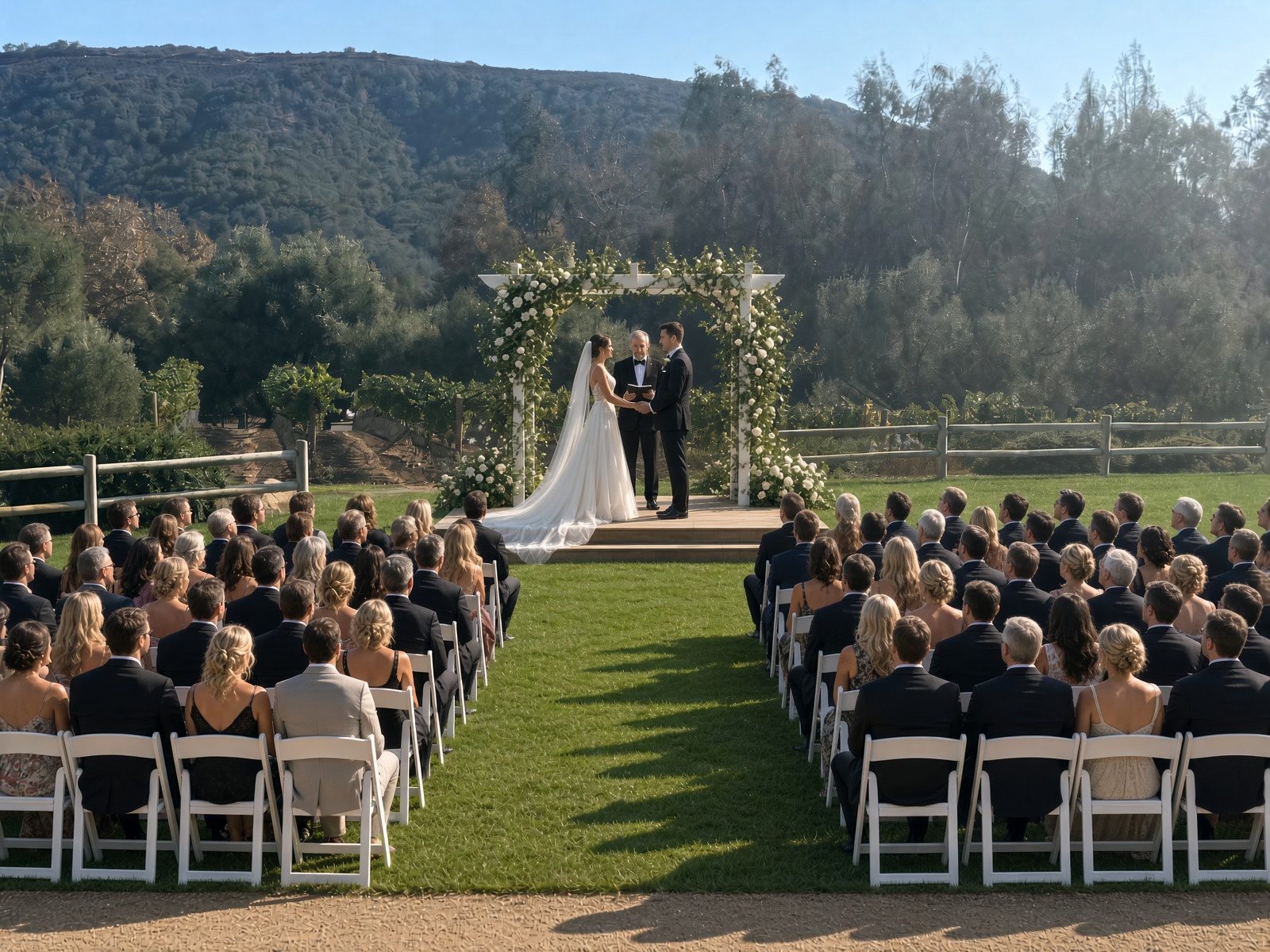
Gatherings of up to seventy-five. A ceremony on the south lawn, cocktails on the terrace, dinner outside. The suite is booked only on Airbnb.
Inquire